
A frame within a frame can easily become a visual trick. But when it works, it does more than guide the viewer’s eye: it changes how we enter the image.
I have seen artists use the technique beautifully and often found myself asking why it worked in one photograph but felt forced in another. The answer is less straightforward than it first appears. A frame is not enough on its own. It needs to add something to the story, the feeling, or the way we see the subject.
I made this photograph in Colombo during my trip to Sri Lanka in the summer of 2026. I was not actively looking for a frame-within-a-frame image. I simply came across it.
Walking Away From Colombo’s Obvious Sights
It was my first day exploring Colombo. Before visiting the places everyone recommends, I usually prefer to walk and wander. There is something valuable about seeing a city with fresh eyes, before familiarity begins to filter what feels worth photographing.
A few days later, I might have passed the same scene without noticing it. But on that first walk, everything still felt new.
I headed along the beach in the opposite direction from the city centre. I passed fishermen, homes built close to the sand, and people selling their fresh catch beside the road. I was simply trying to reach the beach, and eventually found my way through an abandoned house that had not survived the test of time.
Only parts of the structure remained. Some walls were still standing, but the rest had disappeared. The building had been stripped back to its bare bones, making it feel rough and vulnerable at the same time.
The Moment the Scene Settled Into Place
What I remember most clearly is the contrast between the materials around me and the beauty beyond them.
The house still had a floor, but it was covered in sand. Its walls remained upright, but its windows were gone. The concrete, exposed brick, and rough edges surrounded a view towards a beautiful and soft looking beach.
Even before I pressed the shutter, I had the feeling that something in the scene was beginning to settle into place.
When I noticed the opening in the wall, at first, I was not entirely sure what felt right about it, but as people walked through the space beyond, the frame within a frame revealed itself.
What made the image more than a compositional exercise was the contrast between the two spaces. The foreground was damaged, rough, and quiet. Beyond it, people moved across the beach with a lightness and joy that almost felt out of place.
That contrast is exactly what caught my eye.
The softness of the sand, the roughness of the concrete, and the remaining brickwork all create separate layers. Over time, I have learned that photographs often reveal themselves slowly. Even though I took this image at the beginning of the trip, the entire trip I wondered how the image would turn out.
Why the Frame Within a Frame Works
The framing choice and subject placement mattered most.
The wall does not only contain the beach scene. It creates a distance between me and it. Standing inside the remains of the house, I felt less like a photographer arranging a picture and more like an observer looking briefly into someone else’s life.
That feeling depended on where I stood. If I had moved closer to the wall, I would have had more time to make the exposure as the people passed through the opening. But keeping some distance from it compressed the view beyond the wall and simplified the image.
The beach, the figures, and the landscape became more contained. There was less competing information, and the frame had more presence without overpowering the people inside it.
The small opening in a damaged wall gave me a short opportunity to observe a moment that did not belong to me.
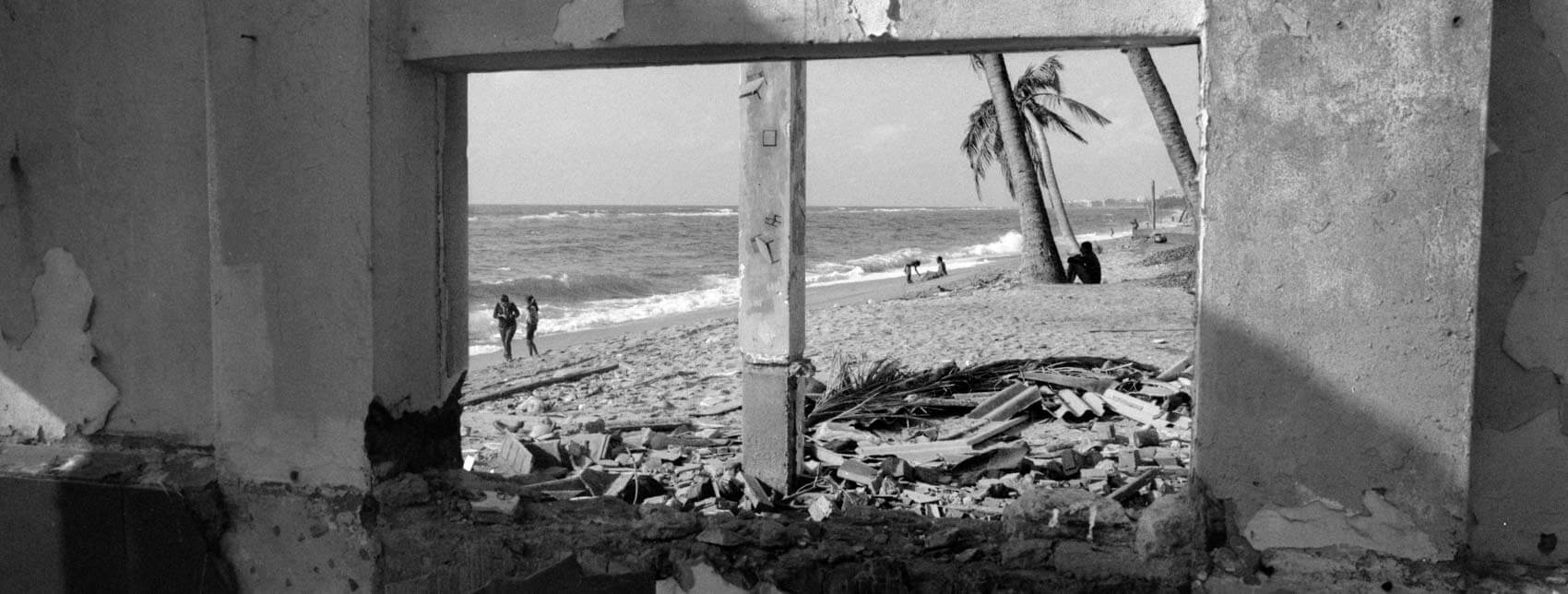
Ilford Delta 400, shot on the 90mm lens on the Hasselblad Xpan
Trusting the Camera With Little Time
The moment happened quickly. Once I saw the potential, I had perhaps 30 seconds before the people would walk out of the frame.
They were strangers moving along the beach, and there was no second chance to position them. I needed to respond with what I already knew.
I had ISO 400 film loaded in the camera. The light was bright enough to work at around f/11, giving me enough depth of field to hold sharpness across most of the scene while still allowing a fast enough shutter speed to freeze the figures in motion.
Looking back, I could probably have chosen a smaller aperture. But that would have meant more thinking at the moment when the photograph needed a decision.
With very little time, I trusted my knowledge of the camera, the film, and the light. It was not a perfect technical calculation, but it was the right practical choice. The people were there, the composition had settled into place, and the photograph was waiting to disappear.
What This Photograph Taught Me About Surprise
If this image taught me anything, it is that favourite photographs are often unplanned.
I had walked away from Colombo’s obvious sights and headed in the opposite direction, not specifically in search of photographs, but with my camera ready for whatever appeared.
Sometimes a photograph works not because more is happening, but because less is in the way. The ruined structure removed the noise of the wider beach and left only a small, concentrated view of the life beyond it.
That is often where the emotional weight of a frame begins to breathe.
Photographs like this also remind me why the printed image matters. The grain, paper surface, and physical presence of a print can hold the quietness of a scene in a way a screen cannot. Grain & Paper exists for exactly that reason: to give selected film photographs a more lasting, tactile life.
This is still one of the frames I return to when I need to remind myself what I am looking for.


