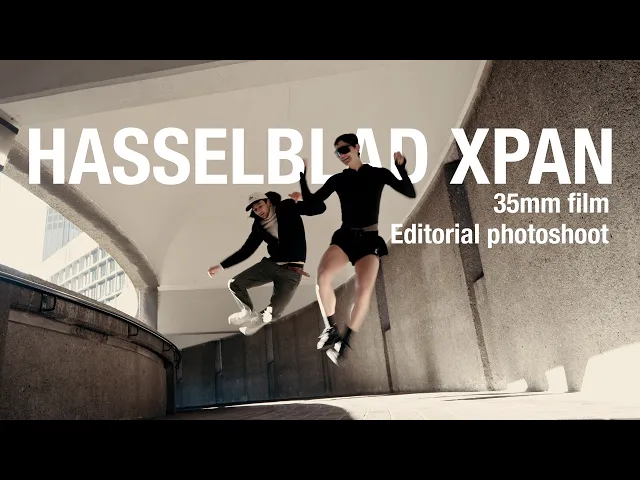
Editorial photoshoot concept
This editorial photoshoot began with a simple idea: to test movement-based storytelling on the Hasselblad XPan and see if a running sequence could feel cinematic.
I wanted to work with my friend Maud, who is a model and mainly works in sports. We both wanted to create something that suited her current career path more closely and added strong images to her portfolio.
The challenge was to create a portfolio-worthy editorial project with the Hasselblad XPan. Editorial photography usually combines narrative, mood, and context, and it is often used in magazines, features, and fashion stories. I had shot for magazines before, but I had never created a story-led movement set on the XPan.
The key was that the mood of running and the narrative should be clear within only a few frames. Even though this comes close to a portrait session, the difference is that the images need to work together as a sequence or series. The sum has to be bigger than each individual frame.
I will not lie, I was nervous.
Why This Editorial Photoshoot Mattered
This editorial photoshoot was also a technical and creative challenge, because I wanted to test a repaired XPan while pushing my own boundaries.
I like putting people in places where they feel most comfortable. I believe that not every type of photoshoot fits every person, even if some people are very versatile. You can usually tell when someone is in their element. In this case, I wanted to place Maud in a setting where she would shine and challenge myself at the same time by creating an editorial photoshoot about running.
Running has many elements: movement, clothing, stretching, and mindset. Yet, easily done with others, it is often done alone, and here I wanted to show urban running rather than trail running. The key about urban running is that it can easily show hard lines and strong contrast with something fluid and basic.
That contrast between the urban environment and the movement was exactly what I wanted to highlight.
The Hasselblad XPan is not the obvious camera for this kind of shoot. It is a slow camera, one that makes me slow down a lot. Running and sports photography usually ask for speed and lots of frames, which is the opposite of how this camera works. You also cannot fully see what you are shooting as you go, which adds another layer of pressure. Still, those limitations motivated me.
This is also the direction of photography I want to explore more. I have mentioned before that I want to do more context-driven shoots with the Hasselblad XPan, with or without flash, but I had not really done it yet. So this was my first real step towards that.

Left attire inspiration, middle - pose inspiration, right - composition.
All photos belong to other photographers
Creative Direction and Mood
The creative direction for this editorial style photography shoot was built around sunrise, stillness, and the contrast between soft movement and hard architecture. I wanted the running to read as a visual narrative rather than a literal sports sequence, so the images would suggest motion through gesture, posture, and mood. That tension is what makes the frame read as editorial rather than documentary or commercial. I was not trying to show running in a literal way. I wanted the images to suggest it through gesture, silhouette, and the rhythm between frames, so the viewer could feel the story without needing it explained.
I had chosen the Barbican for its hard geometry, concrete surfaces, and sharp lines, which created a strong contrast against Maud’s softness and fluid movement. That tension between body and architecture was central to the concept.
The goal was to build an editorial that felt cinematic and story-led, with the Hasselblad XPan’s panoramic frame giving the sequence the rhythm of a film still rather than a product-focused fashion image. I wanted the result to feel like a sequence with atmosphere, visual rhythm, and a clear narrative arc.
Technical Setup for the Editorial Photoshoot
I tried to keep the editorial photoshoot minimal and remove distractions rather than introduce more. Since I only planned to fill one roll of film, I only needed one camera setup.
I used the Hasselblad XPan with the 45mm f/4 and 90mm f/4 lenses. The Hasselblad XPan 45mm lens was for more context-driven shots [link to the 45mm lens]. It is the widest lens I have, and it gives a good balance between compression and width.
The 90mm f/4 lens was for detail and separation [link to the 90mm lens]. It is excellent at isolating the subject and reducing distractions, with a strong blur even at smaller apertures.
I shot on Kodak Portra 400, and I also brought ISO 800 just in case. The forecast called for sunshine, so I expected Portra 400 to be enough.
The combination of one roll of film and the lens choices forced me to be intentional. I had to look carefully at every angle and every spot before taking a frame.
The XPan meters the scene from the centre rather than with a spot meter [Link to spot metering Xpan], so in high-contrast light it does not always give the result you want straight away. For that reason, I also used my digital camera as a light check when something felt off. I only needed to do that once.
I metered for the bright sunlight because I wanted a more cinematic editorial look, which meant letting the shadow side remain shadow.

Shot on Kodak portra 400
Shoot Process at the Barbican
It was 5am when the alarm went off.
It was time to get up and make my way to the Barbican in London for an editorial photoshoot with Maud.
When we arrived, we did a quick loop around the Barbican so we could understand the spaces we might use. I already knew the light was not great everywhere, but at least I could get a feel for the layout and where the light might fall at what point in time.
Once we started shooting, I kept moving Maud through the spaces in order for her to optimally use the sunlight. In the morning the light moves fast and you will especially notice it when you are working with light rays between tall buildings in the early morning.
As soon as I saw how the light hit a specific area, I gave Maud directions and showed her what to do. I then had to find the right angle and position to photograph her. Sometimes I demonstrated what I wanted and then left space for her to interpret it in her own way. Because the light was limited and time was short.

Still from video
I looked for locations with a strong interplay of light and shadow so I could create contrast. I wanted Maud in the light and the surrounding elements in shadow, which helped reduce distractions and increase separation between subject and background.
The camera was slow, and so was I. Sometimes Maud had to repeat the same movement many times because I had missed the exact moment I wanted. In some cases the position of the legs was not quite right and required her to do it again. Luckily, Maud was a champion and kept running back and forth.
My nerves were high at the beginning because I was not sure whether I would come home with anything special. As the shoot progressed, I relaxed and began to enjoy the process more. That helped me communicate more clearly, and with trust and patience we made it work. I believe she did 12,000 steps that morning and that was mostly because I let her do every movement at least three times.


Selected Final Images From the Editorial Photoshoot
The creative direction for this editorial style photography shoot was built around sunrise, stillness, and the contrast between soft movement and hard architecture.
Out of the 20 images I shot during the editorial photoshoot, I did not love all of them, which is normal. Luckily, a few frames really stood out.
With an editorial, you usually want a narrative, mood, and context, so I aimed for a wide contextual frame, a medium-distance image, and a close-up.
The first image provides context and contrast. I placed Maud to the side of the track so her upper body was lit by the sun and her shadow fell onto the wall. Even though you do not see the run in a literal way, the activity is clear. The width of the frame works well here because it gives the scene space to breathe while still carrying the story.
The second image shows Maud looking into the distance as the curved track leads up and away out of frame. That shape drew my eye immediately. It uses the width of the frame well, and every part of the image adds something to the story.
Lastly, the close up. Even though the sun had already risen to a certain point, that it was almost impossible to get her full head lid by the sunlight evenly, but that also made the frame feel more natural and less controlled. It makes it feel like a more natural moment caught on film. II had her reach for her glasses to give the image more structure. Because the XPan frame is so wide, close-ups can easily feel too empty, so her hand and arm help her feel larger in the frame. To prevent too much breathing room around her, her hand and arm make her feel larger in the frame than she actually is.
What This Editorial Style Photography Shoot Taught Me
I started the editorial photoshoot with certain images in mind, and because I was so focused on those frames, I did not experiment enough with movement. I only realised that in hindsight, once I got the negatives back. I could see that running images with intentional motion blur might have added more depth to the series.
Reflecting on the images, I realised that an editorial photoshoot or series is not about one exact moment. It is about a narrative or a sequence of events that contribute to the larger story. The images can even be made across different times of day, or different days entirely, as long as they still serve the same idea. In this case, because it was about a single run, the light and the location had to stay consistent.

Shot on Kodak portra 400
I also realised that because the Barbican is so large, and because time was limited by the sunrise, a location scout would have helped a lot. It would have been better to understand how the light fell before the shoot day.
This shoot made me realise that I love creating concepts with people, but I still need room for improvisation. Planning is essential, but the question is how detailed the plan should be. If every single detail is planned, the creative space disappears and I end up only executing and losing the joy in things.
In short, I am happy with the results we produced, the preparation we have done and the narrative we have created. It indeed can be done better, but generally speaking I am happy about the results.
Next step
Do the things you love, even when you do not fully know the outcome, because that is how you push your boundaries and explore new areas of creativity.
The editorial took a significant amount of planning and communication, but when it worked, the narrative and quality of the series became clear very quickly.


