Japan hiking in a lesser-known area
Kyushu is a distinctive island that remains relatively undiscovered by international tourists but is well loved by Japanese travellers. It is famous for its volcanic activity and the many onsens (hot springs) that accompany it. No matter which part of the island you visit, you will find streets filled with warm clouds of steam rising from the thermal water.
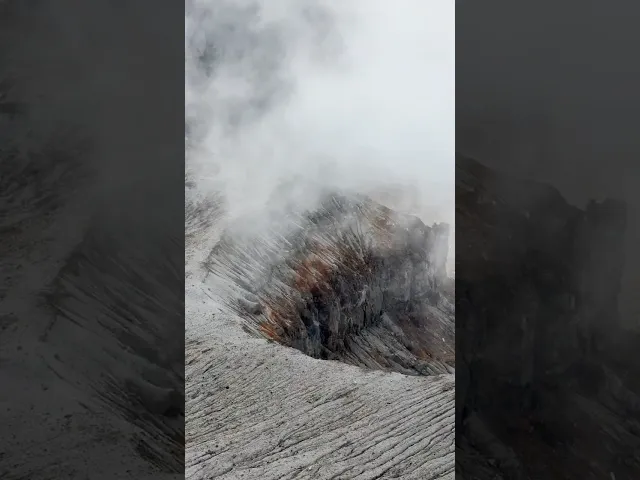
Part of the reason I traveled to Kyushu was traditional lifestyle and the famous volcano I could climb. Japan hiking has long been high on my bucket list. The last time I visited, I couldn’t climb Mount Aso because the area was closed due to volcanic activity. This time there was a chance that it was open for a sightseeing. However, it was also a gamble, because it is not uncommon for parts of the island to be closed off overnight due to volcanic activity. Even though volcanos can be quite predictable, the fumes they produce can be unpredictable. Despite this uncertainty, I love hiking through dramatic landscapes, not just for photography, but for the experience itself.
Volcanoes create otherworldly landscapes over time through extensive lava flows. Although I’ve visited many volcanoes before, I rarely photographed them. For some reason, Mount Aso sparked my interest and inspired me to create a photographic series around its vast volcanic terrain.
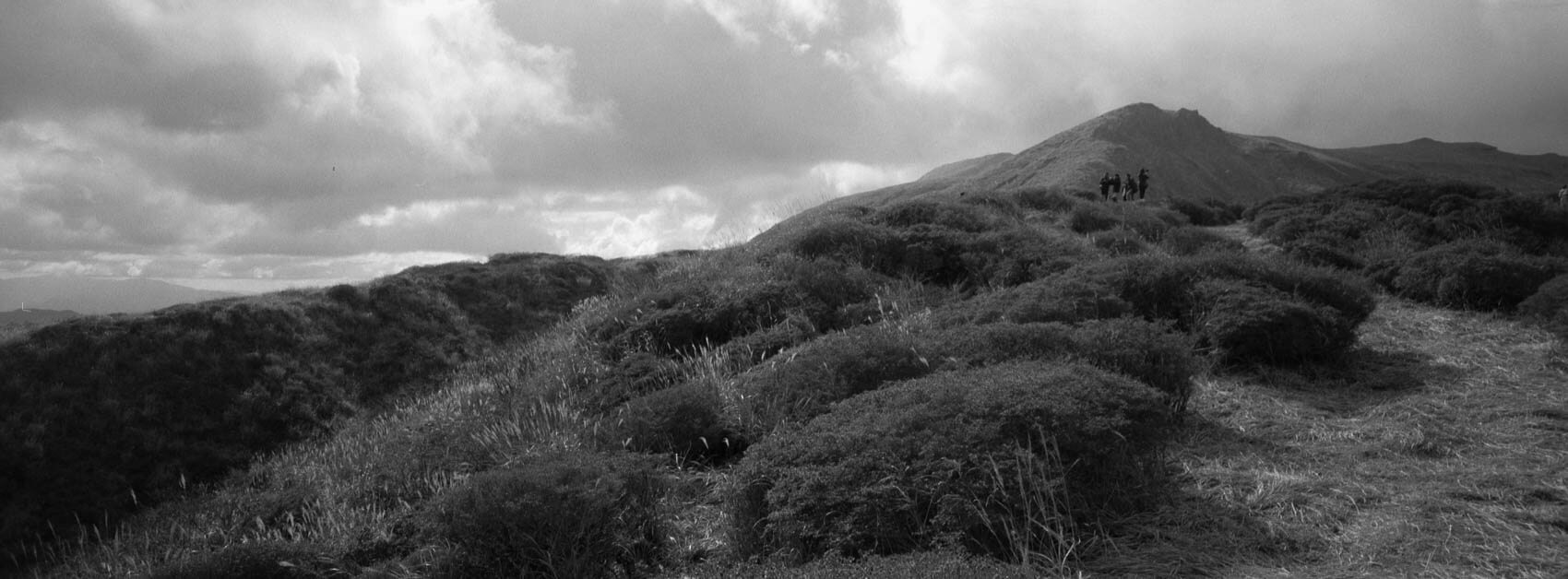
Ilford delta 100 black and white - shot on Hasselblad XPan
Hiking with a bad plan
Hiking in Japan is generally “easy” in the sense that signs are clear and maps are reliable, though the physical demand remains. To get to the volcano, I had to take train and followed by a bus. It took me roughly 2 hours to get to the starting point from where I was staying. The first train ran after sunrise and the last bus returned before sunset, which was unfortunate, as sunrise and sunset are my favourite moments while hiking.
I didn’t have a choice and arrived after sunrise, spent the day hiking and exploring and was so intrigued by the beautiful scenery that in the spur of the moment I decided to risk missing the last bus to see the sunset at the volcano. That meant an additional three-hour hike down the mountain instead of a twenty-minute bus ride, on top of the nine-hour hike I would have completed by then. Unless I met some people on the mountain that were kind enough to give me a ride to the nearest train station. I hoped to meet someone kind enough to offer a lift to the nearest train station. Either way, I was confident I could still make the last train home, which left around 9 p.m., giving me enough time even if I had to hike back entirely on foot.
Hiking for me is a way to disconnect, to be present, and to find calm in the act of moving. It allows me to either lose myself in thought or absorb the beauty around me. When I hike with a camera, I constantly shift between introspection and observation—moving between searching for abstract, otherworldly shapes and simply being grounded in the moment.
Balancing hiking and photography in Japan
When I first started hiking in Japan, I struggled to balance my desire for quintessential Japanese landscapes with the raw natural beauty I found. I expected “Japanese” scenes with distinctive markers, yet Mount Aso taught me that the landscape itself was striking enough. My camera could only capture fragments of its vastness.
At first, I pointed my lens at anything that caught my attention, often deciding not to take the shot. Over time, I learned to lift my camera less often. Seeing compositions became more intuitive, and the act of hiking and photography merged. Many hikes end without a single photo taken, which I never consider a failure. In this case, however, I returned with a collection I was deeply proud of.
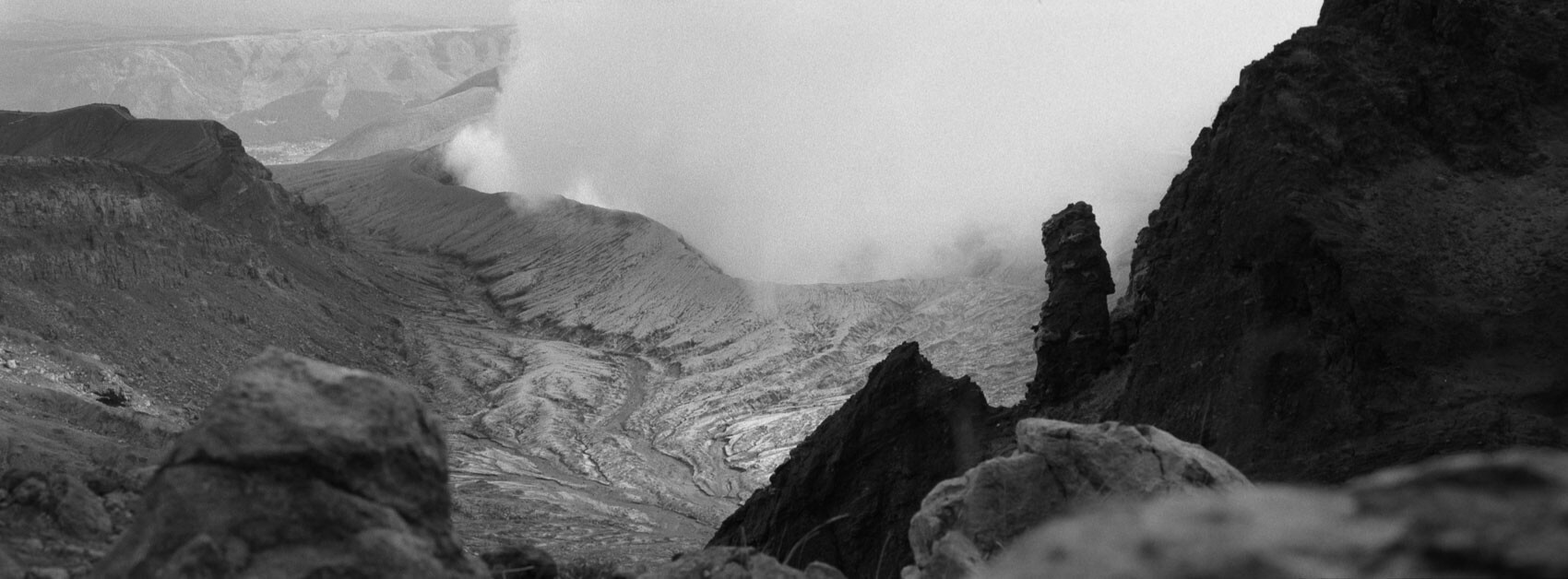
Ilford delta 100 black and white - shot on Hasselblad XPan
The Spirit of Place in Black and White vs Color
Before you load a roll of film you are facing the difficult choice of black and white vs colour. The choice completely arbitrary when I arrive, because the choice is often made for me. The camera either still contains film or the weather and the environment weigh in on the choice. For this hike, my camera already contained black and white film, though I felt that colour might be the better option for the vivid hues around me.
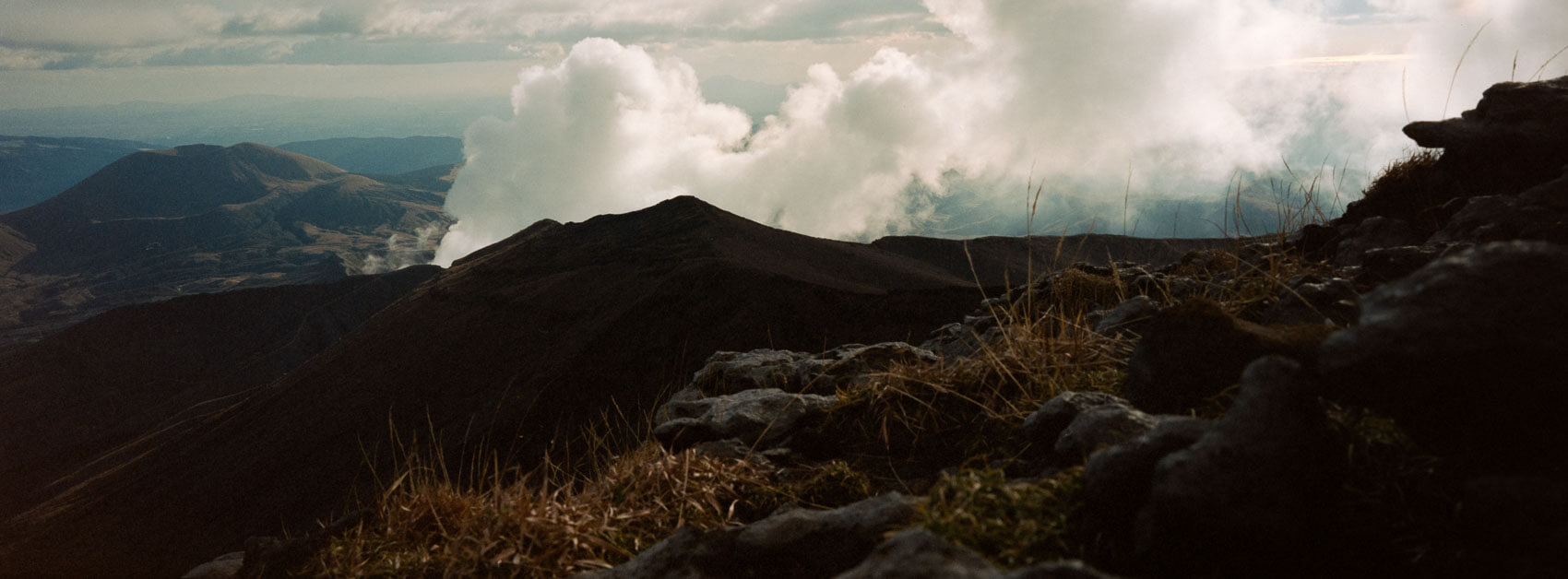
When I arrived, I immediately noticed the tones that defined the landscape: deep black volcanic soil, gradients of grey and white smoke (same colour different shade, if considered a colour at all), beige earth and a hint of red/yellow. I usually prefer images with no more than three dominant tones, and often define my photography as either monochromatic, analogous or triadic. This landscape had exactly that.
After quickly finishing the remaining black and white film, I switched to Kodak Portra, and that’s when the series came alive. My intention was to shoot a series that would reflect an otherworldly place with some hints of human in there either for scale or to make it relatable, yet the references should be subtle. I wanted the images to feel as though they could have been taken in the 1980s or decades into the future.

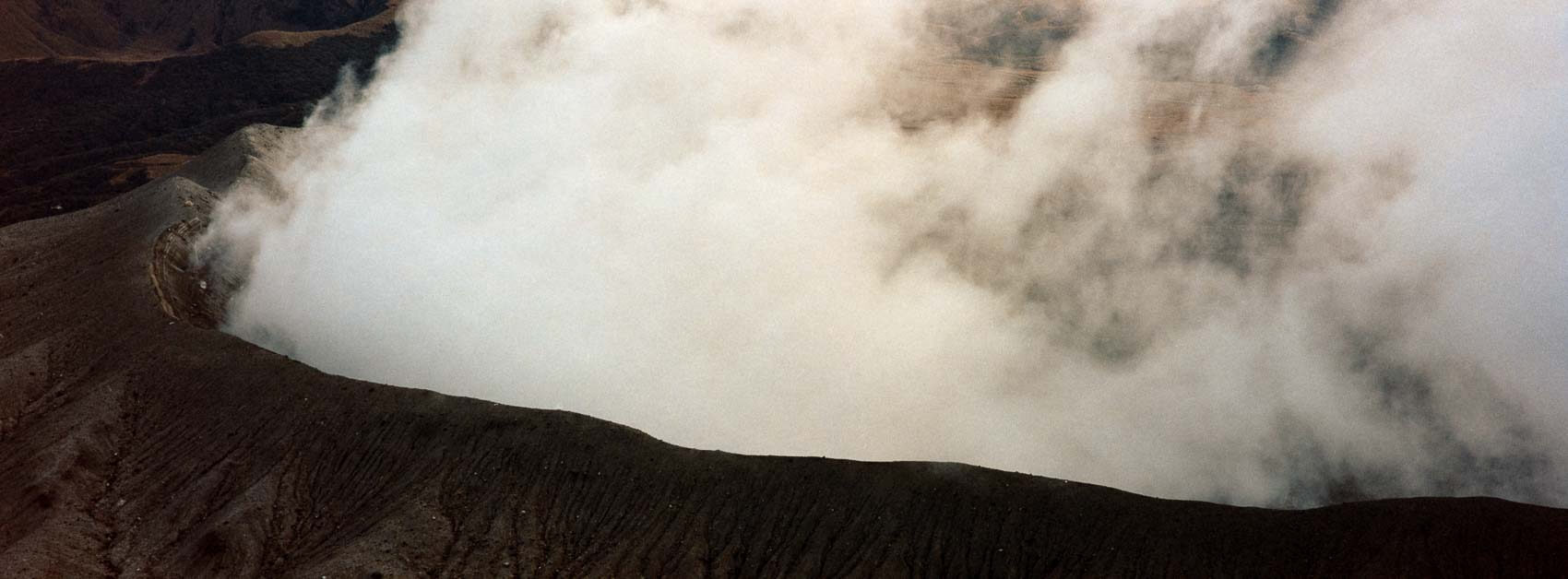
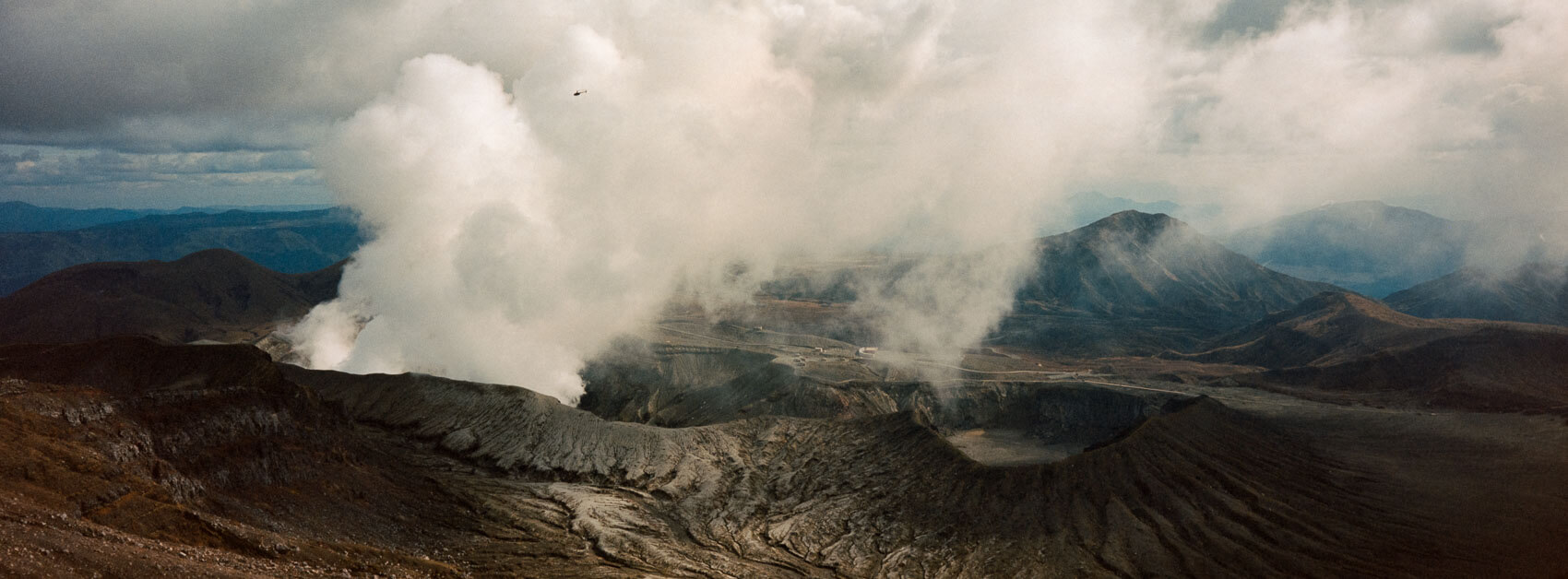
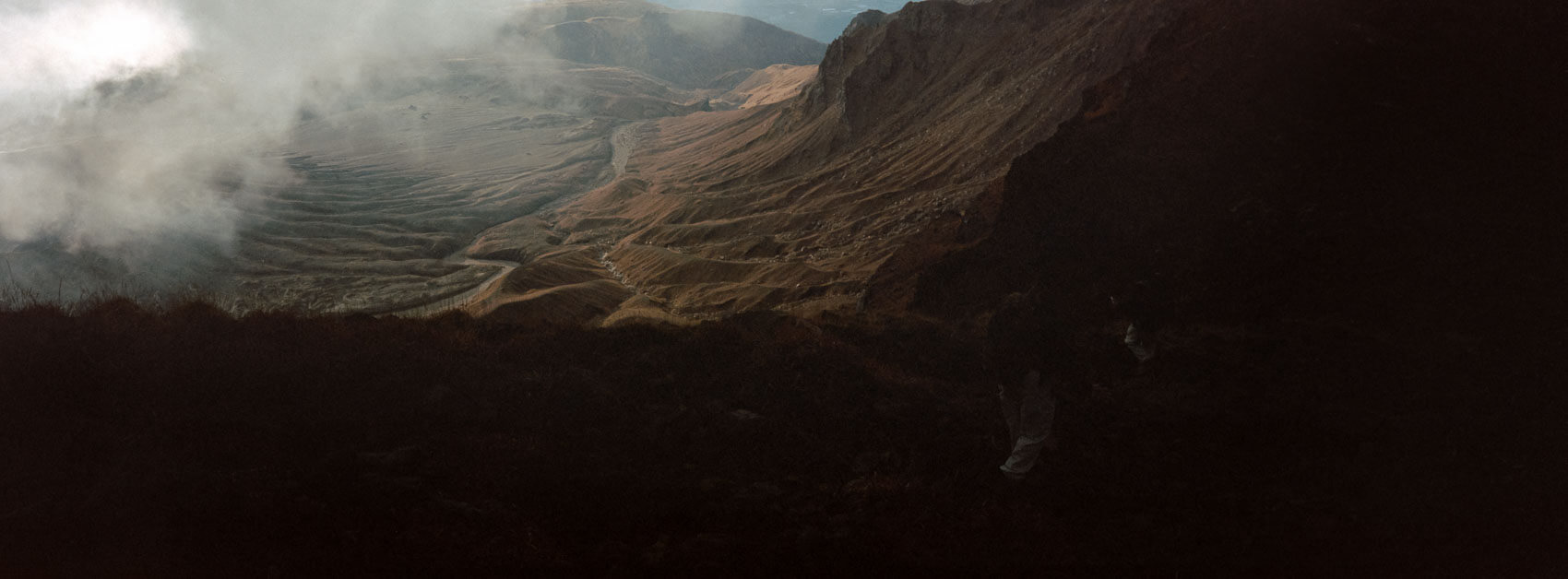
Deconstructing the Series
As the vastness was very impressive, one tends to take photos of the entirety of the place, which is not wrong. However, I knew that I only wanted to have 3 or 4 images showing the entire place and the rest of the series to focus more on the details of this vast landscape.
To create visual interest, I used contrasts of texture, shadow, and light. For example the rough, angular rock set against the soft, rolling clouds of volcanic steam.
Light changes quickly on the volcano, testing my patience. Rather than waiting endlessly for the perfect glow, I sought naturally balanced scenes of dark and light surfaces. The challenge was exposure: dark earth contrasted sharply with luminous clouds. When executed properly, the interplay of tones became striking. My compositions explored light-defined lines, uneven ratios of brightness (often 70/30), layered mountain ridges to add depth, and leading lines created by volcanic contours.
Documenting Japan hiking and Interpretation
As the day went on, I took fewer photos. This gradual restraint helped me transition from documentation to interpretation. I wanted to capture images that felt personal, ones that reflect the vastness, the beauty and the introspection that hiking in Japan always evokes.
I often ask myself: What do I want to capture artistically? How do I tell the story of the vastness of the landscape? How can I make my images more than simple records of where I stood? The answer lies in merging memory and artistry, using photography to express how it felt to be there, not just what I saw.
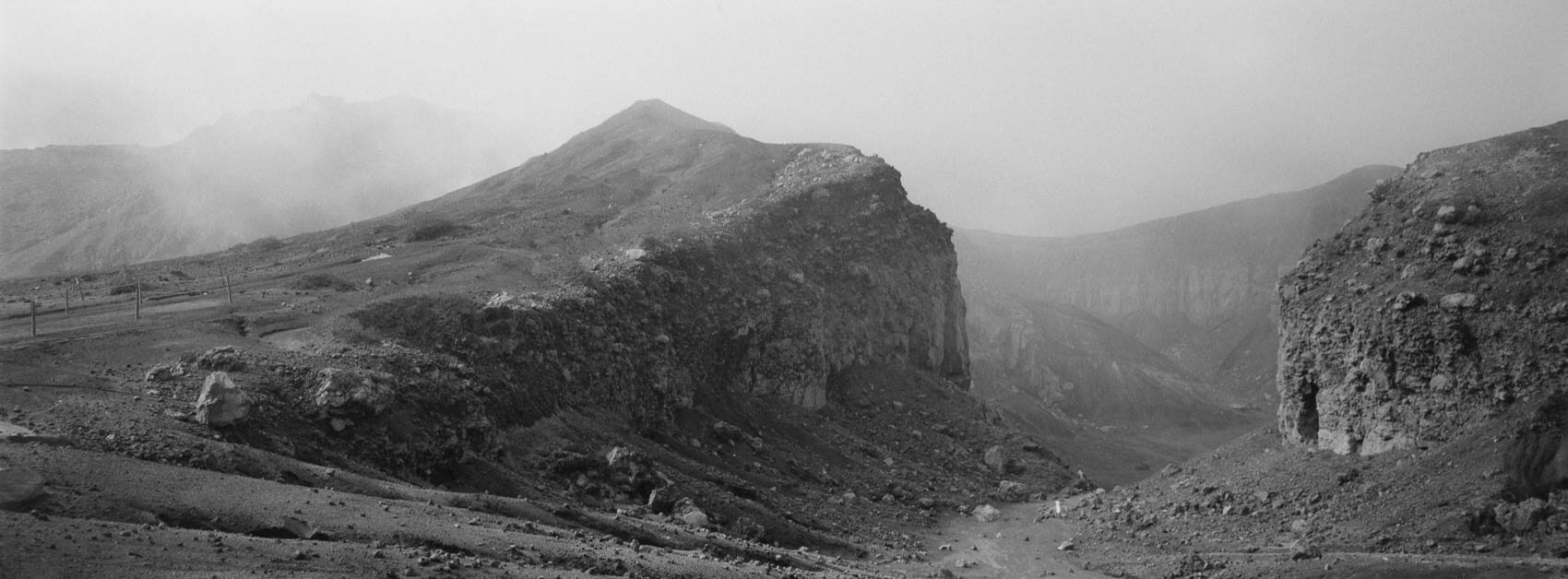
Ilford delta 100 black and white - shot on Hasselblad XPan
Artistic Reflections and outcome
No matter where I go, I am more inclined towards capturing images of people or a combination of people and landscapes than just pure landscapes, see my Philippines, Italy or NYC film photo series. It is often the adventure I have or the people I meet that make a mark. Still, I occasionally included small, distant figures to suggest scale and evoke the physical effort of the hike.
Eventually, I accepted that I would miss the last bus and continued my descent with quiet peace. As the air cooled, I met two kind hikers who offered me a ride back after sunset. Together, we watched the fading light from the ridge and made our way to the car, grateful for both luck and good company.
I hope the resulting series captures the spirit of adventure, the serenity, and the vast, otherworldly character of Mount Aso. The photographs are a blend of freedom and reflection, a tribute to what Japan hiking truly means: connection to land, light, and the moment itself.
Would you take on such an adventure?


