Japan, culture and wide frames
Japan has a special place in my heart, as I was lucky enough to do an exchange there when I was a student. I spent eight months living and studying on the north side of Tokyo, which meant I got to know the country in a different way than if I had just travelled through. Every weekend I could be found somewhere in the city, exploring different areas, learning about cultural traditions, eating amazing food and much more.
Although a lot of people travel to Japan these days, many of their “ways” are hard to grasp unless you take a deep dive. Some things simply cannot be understood without understanding the culture first, and getting to know someone’s culture takes time. Their culture is so different from the one I grew up in and has so many hidden layers that I feel like I only got to know about 25% of the “real” culture. It continues to fascinate me. More and more, I found myself using panoramic film and long, horizontal frames to try to fit a little more of that layered culture into a single scene.
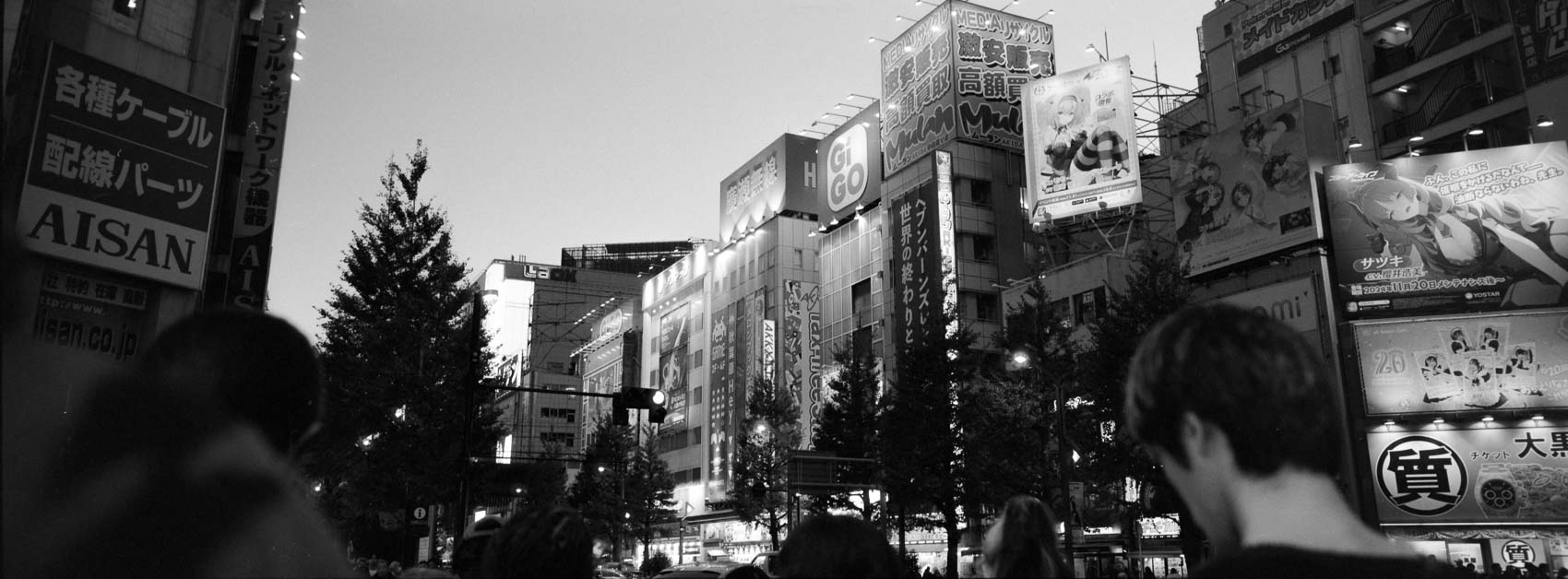
Ilford Delta 400 ISO shot on the Hasselblad Xpan
The order in the chaos in the Tokyo metro
Japan is very different in a lot of ways, and even on the street you notice it immediately. A place like the famous Shibuya crossing might be packed with people, but it rarely feels chaotic or overwhelming because there is always a sense of order in the apparent madness. One of the things that still fascinates me is the train and metro system they have developed over the years, in my eyes, it is close to flawless.
In many countries, the people who operate trains are not necessarily respected, but in Japan it is the opposite. They clearly have the respect of the people, and it shows why: the trains are punctual, precise in where they stop, and clean. That respect really stood out to me and made me want to photograph it. However, on the train there are certain etiquettes, one of them being that you do not take photographs of people. So the question became: how do you honour that etiquette and still come home with a frame that one day deserves to become a panoramic photo print on your wall?
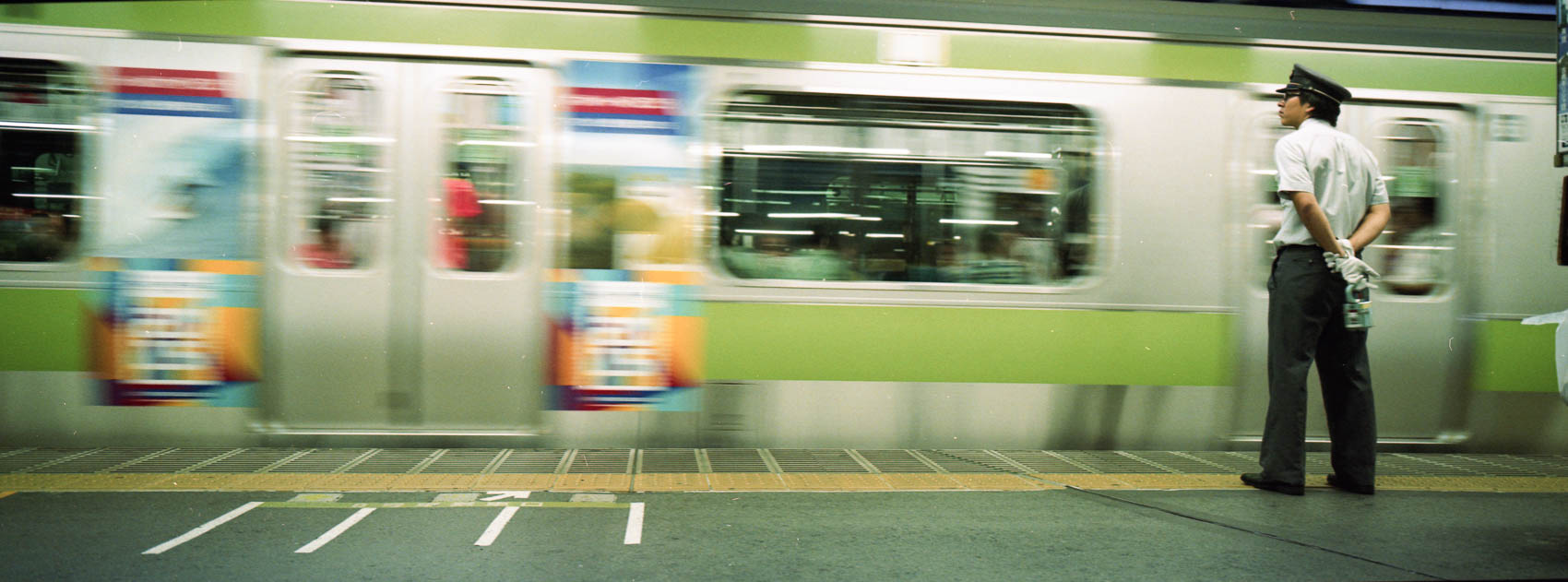
Kodak Portra 400 ISO shot on the Hasselblad Xpan
Working for the Shot in a Horizontal World
Once I knew I wanted a photograph of a train that showed a typical Japanese cultural phenomenon, I had to figure out how to get it without breaking cultural rules. It has become one of the many Tokyo street photography tips I share with people who travel there: take plenty of photos, but never in the metro. To find a way that felt respectful, I started taking the metro a lot, looking for patterns. I visited different stations to study the light, possible compositions, and how trains arrived and departed.
At some stations there were staff on the platform announcing the next train, its departure time, and so on. Most importantly, they would signal to the driver whether all doors were closed. This only happened at stations where the platform curved and was partly out of view for the driver. These staff members are crucial during peak times, as people tend to cram themselves into the train and block the doors while doing so. Those curves and sight lines already made me think in terms of filling the frame for a horizontal art piece, accentuating how the platform stretches, and the gesture of one person can anchor an entire wide frame.
Finding Patterns That Deserve a Panoramic Print
Which brought me to another pattern that was harder to spot. I figured out that the operator of the train would always check the train from his or her window before departing. Some stations had monitors which allowed the operator to see it all from the cabin, yet still the operator would make the movement of looking out of the window. I then knew which shot I wanted to get.
I just needed to find the right spot with the right light and curvature of the platform. I went to many different stations and eventually found an unknown station to me with the perfect light setup. I then knew I just had to wait. When you plan to turn a frame into a panoramic photo print later, these small decisions suddenly matter more: where the operator stands in the frame, how far the train bends, how much negative space you leave at the edge of the print.
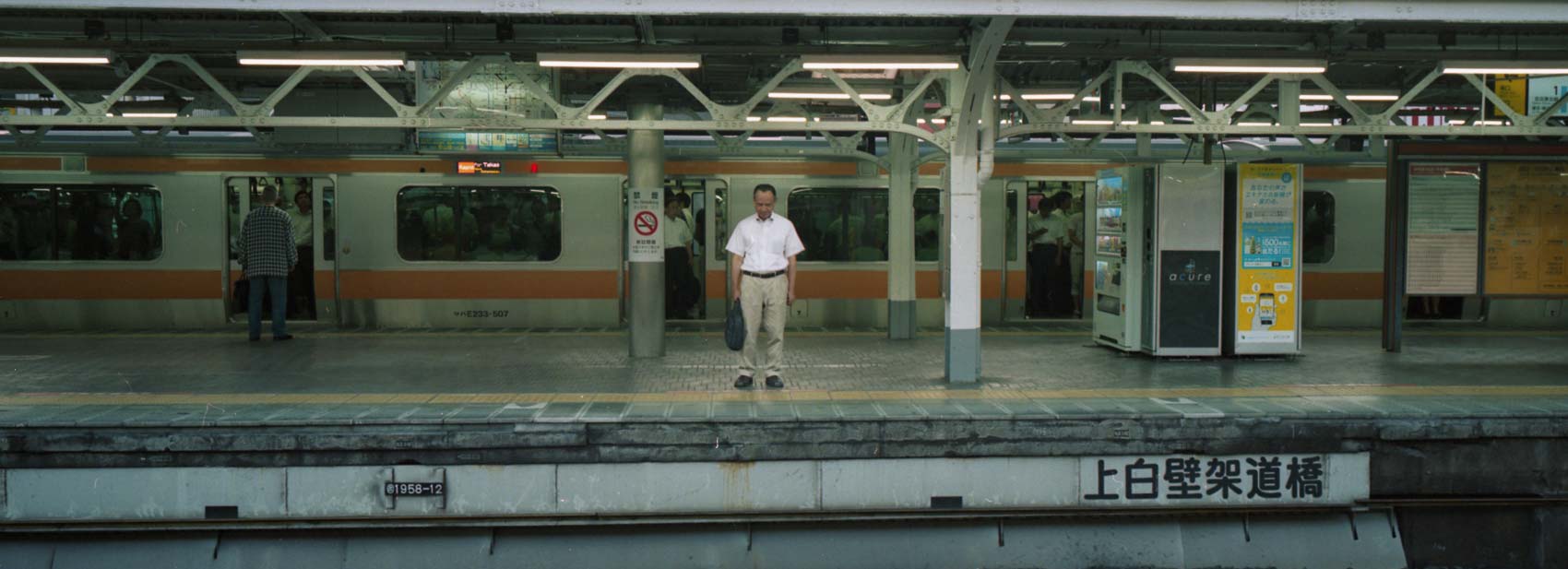
Kodak Portra 400 ISO shot on the Hasselblad Xpan
Translating cultural craft in a print
After having lived in Japan, I knew a few things that really stand out in Japan. One of them is honing in on your craft, but also accepting that specialising in a craft is not an easy feat. Japanese tend to become one with the craft they practice, it becomes a way of life. In this instance I had chosen a slow camera and a subject I knew very little about. Therefore it would require patience to find the right place and moment.
Due to Japanese simplicity, and thoughtfulness in everything they design, I really liked the scene in colour. You could easily argue that the metro would probably benefit from black and white, but in this case, I wanted to show that even colours in the metro system have a purpose. Each line has a colour, as each line also has a sound when it arrives and leaves, making it possible for handicapped people to understand which line is what at all times.
The XPan Frame: One Shot, Many Decisions
Once I had found the right metro station, I just had to wait and determine the perfect location on the track. Every train was the same length, every train stopped at the exact same spot, every train had the same procedure. Therefore it wouldn’t be rocked science to get it right. However, the train operator would be different every time and not every operator would execute the procedure in the same way. Some saw me with my camera and changed their routine. Therefore, I had to be patient and wait for the perfect moment. Which luckily came with the fourth train.
Considering the environment, I knew I would be keen on using faster film. However, I also knew that I wanted to play with a bit slower shutter speed to get shots of blurry moving trains. I was looking for a balance of fast enough, but not too fast. I ended up choosing the Kodak Portra 400 ISO, it allowed me to shoot hand held with shutter speeds that might be questionable in dark areas, but fast enough that with enough light would result in sharp images. That balance is important if you plan to make large panoramic photo prints later, because motion blur that looks interesting on a phone can easily fall apart when it stretches across a long piece of paper.
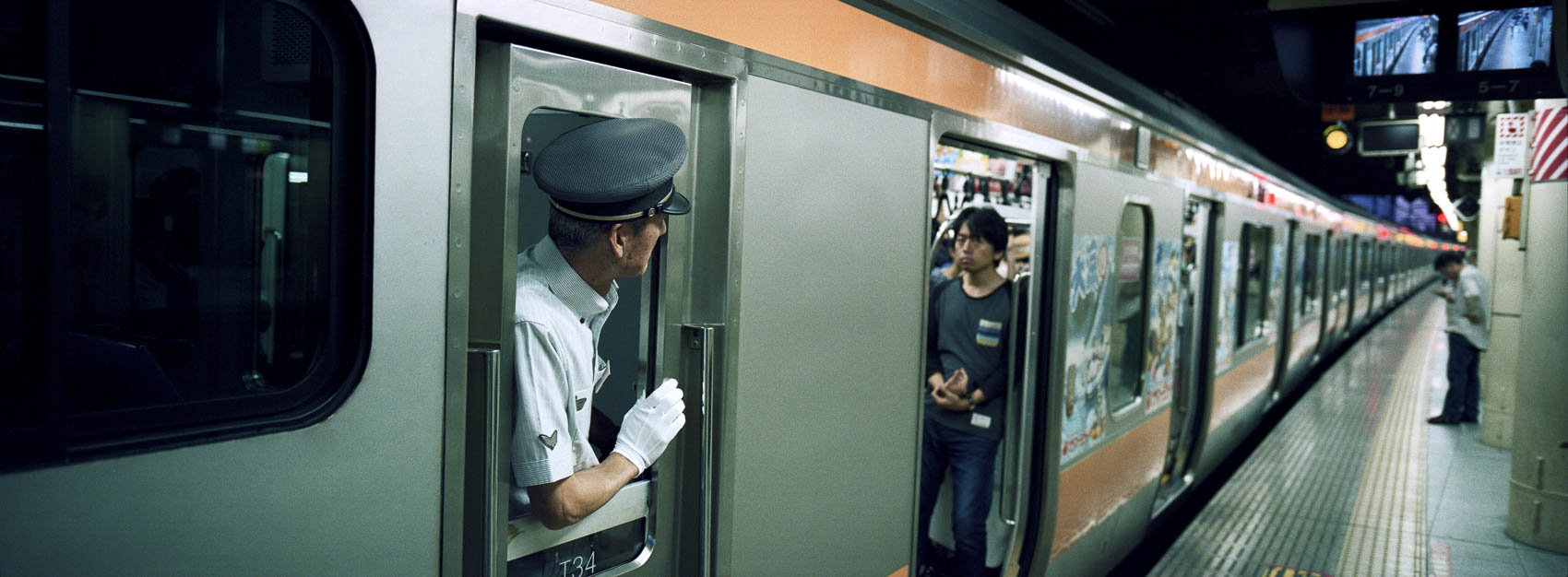
After some thorough film photography mindful practice, whilst waiting for the proper train. I saw the fourth train arriving. I had predetermined that I would shoot at f5.6 and a shutter speed of 1/45, I then hoped for the best and clicked the button. The train operator in perfect position, the doors still open exposing the people in the train, whilst the train curves to the right on the track, filling majority of the frame. I hoped I got what I saw, because I only took one frame and went home straight after.
Kodak Portra 400 ISO shot on the Hasselblad Xpan
My Favourite Tokyo Panoramic Photo Print
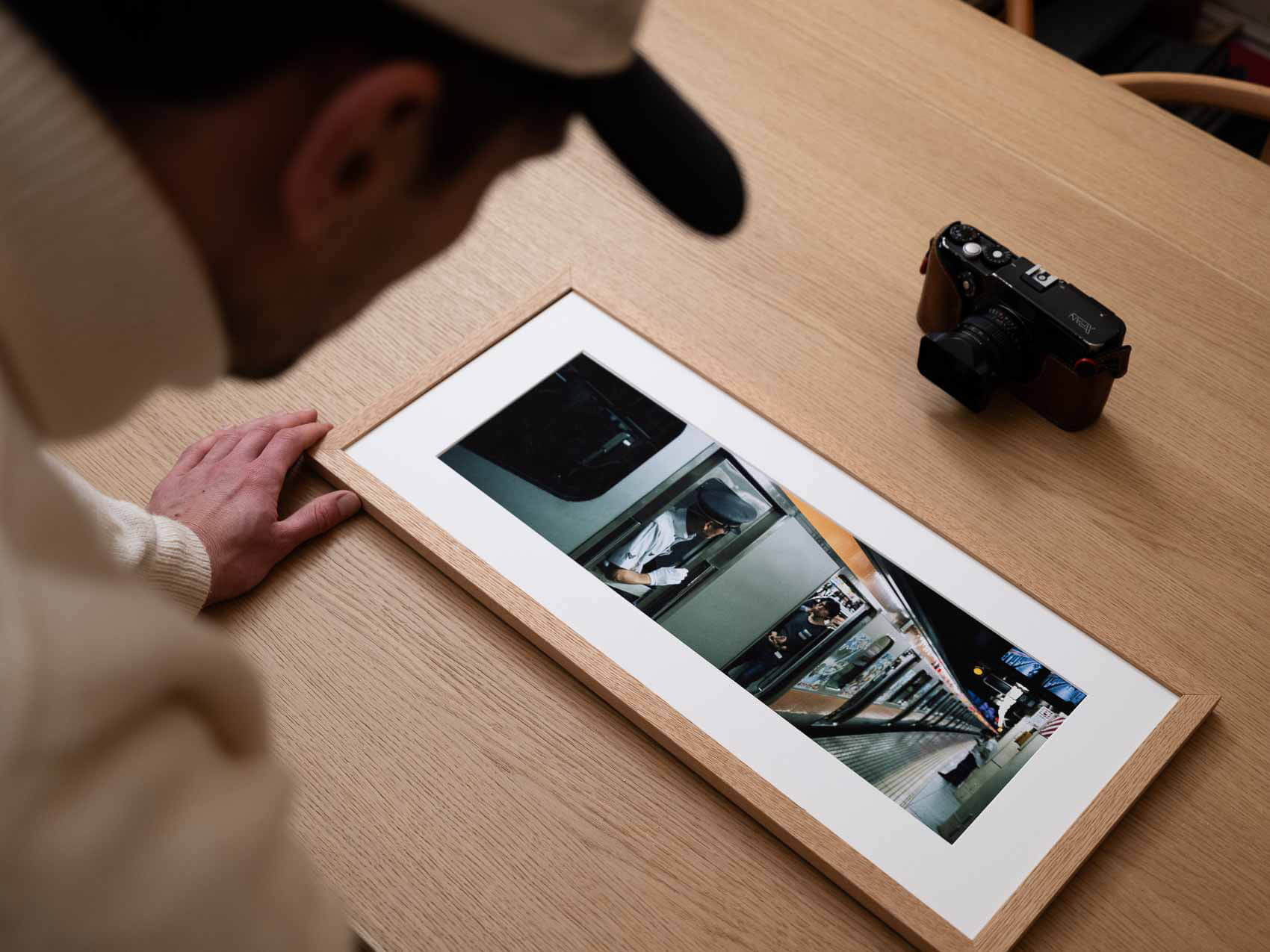
I love this analogue film shot, because I really feel like I am part of the scene, and it works really well with the wide ratio of the Hasselblad XPan. That 65:24 frame is built for panoramic photo prints; it naturally wants to live as a long, horizontal artwork rather than a tiny rectangle on a phone screen. I got close enough to the subject to make the train operator a major part of the photo. Which is one of the film photography composition technique I love to use when shooting. On second look at the image it reveals the doors of the train still being open and the passengers inside. Naturally your eye is being guided that way.
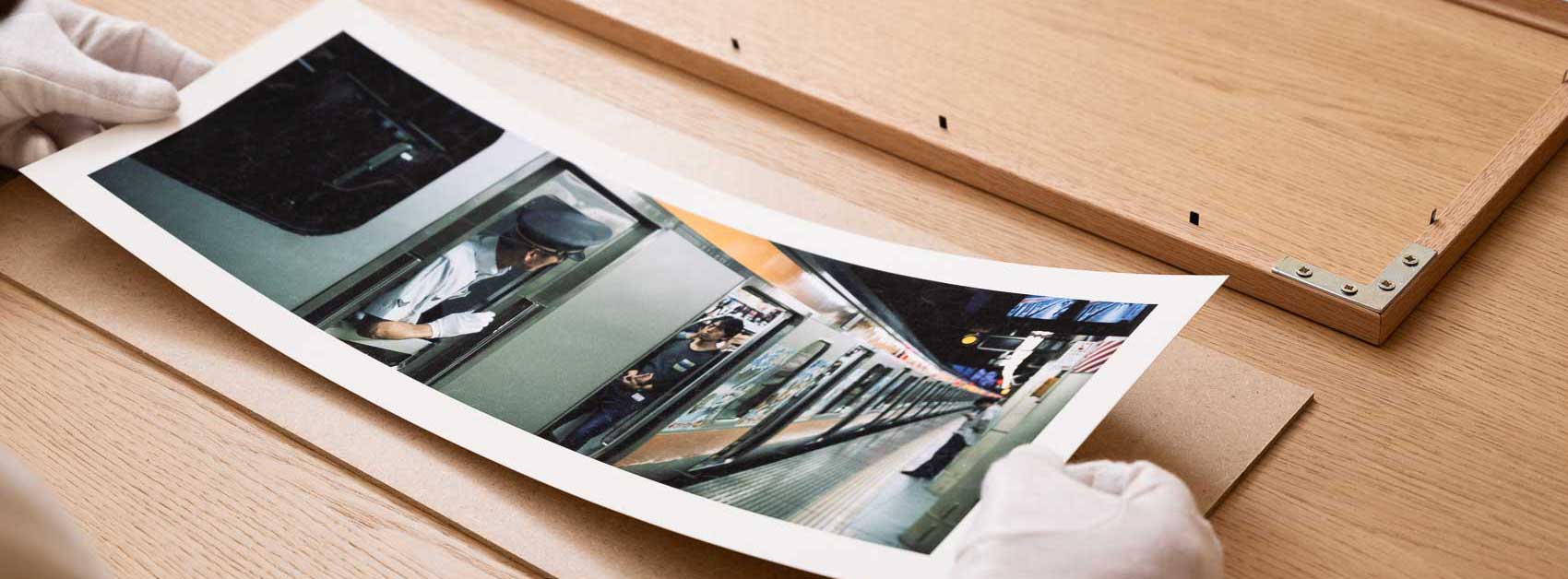
What I like is that the details of his shirt and hat are very clearly distinguishable and make it seem like it was a perfectly planned shot. Whilst it wasn’t, it was just a scene I found on the streets of Tokyo and still follows the Tokyo metro photography etiquettes. Those tiny details are exactly what reward you when you turn the negative into a physical panoramic photo print; you start to notice stitching, textures and small expressions that simply get lost in a scrollable feed.
On a phone the image is strong, but really comes alive when printed. As there are so many details that are more easily seen when regarded in large. Printed wide, the frame becomes a piece of horizontal art that pulls you along the platform: from the operator’s hat, through the open doors, into the soft blur of passengers and the curve of the track. Even though the print isn’t too big, the experience is already completely different. I shoot most of my work with panoramic photo prints in mind first and social media second, as I always aim for an art piece I would like to have on my own wall. When printed in large, the quality of the film and the XPan glass starts to become more apparent. Also the experience of the colours.
If you have a frame from your own travels that feels too wide, too layered or too quiet for a phone screen, try turning it into a small panoramic photo print first. Live with it on your wall or desk for a while. You might discover, just like I did with this Tokyo metro scene, that some moments only start speaking when they become horizontal art you can actually stand in front of, instead of swipe past.